Starting in early 2009, in the middle of the financial crisis when interest rates were at rock bottom, the BoE pumped hundreds of billions of pounds into the economy through the buyout of private assets. That is because the BoE does not have control over money supply any more so has to resort to artificial means by creating money out of thin air to encourage investment and lower interest rates across the economy. This is because most of the money supply in the economy is entirely controlled by private banks. They have complete control over the money supply. So, now we have an entire economy resting on the property market because private banks fundamentally rely on the health of the property market in order to not go into insolvency as mortgages go bad and houses are worth less (meaning the value of their assets falls, which can mean they're lower than their liabilities). This all happened in 2008 and led to a £500 billion bank bailout program including £50 billion of direct state investment in British banks, basically aid money. All because the property market crashed. This and QE prevented a huge depression in the economy and stopped the money supply from collapsing, which private banks almost entirely control by the way. As it slightly improved bank's confidence which stopped the levels of private debt in the economy collapsing (more on that later).
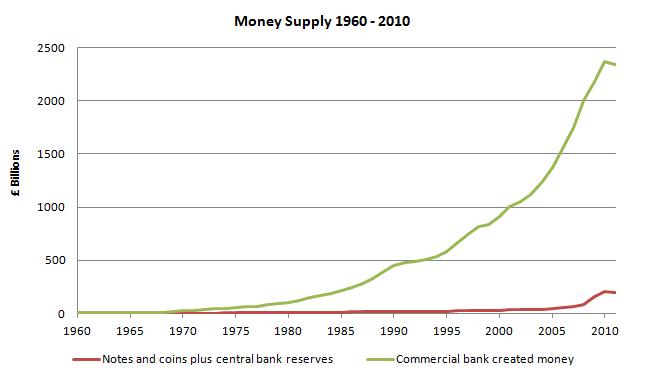 This graph above showed what actually happened to money supply after 2008 and before then. The thing that led the UK's GDP to fall by over 7% was not a complete collapse in money supply, but a period of stagnation, beginning in 2008, putting an end to the 15+ years of insane growth in the money supply by private banks and the BoE had to increase central bank reserves by the most significant amount ever. Yet the ratio of central bank reserves to bank created money is tiny in comparison to the past. The 'reserve ratio' that I literally just read in an economics textbook, doesn't exist, at all. The 'liquidity ratio' that would require private banks to hold a percentage of their liabilities in liquid assets was lowered throughout the 70s until it was eventually abolished in 1981. This is still in place in the US interestingly enough however, set at 10%(!) for institutions with transactions accounts worth over $103.6 million (why this precise figure, who knows) which might explain why the UK's private debt ratio as percent of GDP is one of the highest in the world and almost double the US's (and why the UK suffered far more in 2008 than the US).
But what actually is money supply and why does it play such a huge role in the performance of an economy? Growth in money supply by private banks means growth in debt and debt means a growth in money flow around the economy as it's essentially 'giving' money to poorer people or businesses from richer ones that don't 'require' that money right now. That leads to an increase in spending which stimulates the economy. So debt is absolutely vital. When debt issued by private banks began to fall in 2008-9 because of lack of confidence, the entire economy crashed. And that's exactly the problem: if there's a huge property crash in America, which many people say is where the recession 'started' it affects banks confidence around the world, stock markets crash, governments loosen monetary policy which again, reduces banks confidence to continue increasing money supply as some go into insolvency etc.
So, under this system, debt has to continue rising in order to grow the economy that's a given. If debt levels started to fall, the economy would collapse and banks would go bankrupt.
We really do have an economy that relies on the growth of property prices in order to keep growing. Before 2008, especially under Tony Blair, we saw one of the largest and fastest periods of growth in British history, at the same time, we saw the fastest increase in property prices, quickest increase in money supply and quickest increase in private debt levels. That is the formula for growth.
I'm just beginning to understand this system and it scares me. It's incredibly unsustainable and what's worse is there's no way out. There is no long-term debt cycle. There is no reserve ratio. There isn't any restrictions to money supply. There is no real way for governments or central banks to properly control money supply or the economy. No ability to deleverage. And, perhaps most crucially and controversially: no way to end the growth of inequality without crashing the economy as debt creates inequality.
The entire economy is placed in the hands of private banks and their investors. Financial deregulation has caused the money supply to get out of hand and caused the central government to lose the huge majority of the control they once had over the money supply and economy as a whole. People say the bankers caused the 2008 crisis. Did they? Yes, they stopped lending because they lost confidence, understandably. So, the crash wasn't preventable, it was inevitable. Because of the system we live under.
Inspiration:
Banking System and Money Creation: How Does Banking System Work , How Money is Created and Destroyed: https://www.youtube.com/watch?v=qvrH1O_LS0c
Sources:
http://www.bankofengland.co.uk/monetarypolicy/Pages/qe/qe_faqs.aspx
https://en.wikipedia.org/wiki/2008_United_Kingdom_bank_rescue_package
https://en.wikipedia.org/wiki/Reserve_requirement
Note: Thanks for reading, I had way, way too much enjoyment out of typing this :)
This graph above showed what actually happened to money supply after 2008 and before then. The thing that led the UK's GDP to fall by over 7% was not a complete collapse in money supply, but a period of stagnation, beginning in 2008, putting an end to the 15+ years of insane growth in the money supply by private banks and the BoE had to increase central bank reserves by the most significant amount ever. Yet the ratio of central bank reserves to bank created money is tiny in comparison to the past. The 'reserve ratio' that I literally just read in an economics textbook, doesn't exist, at all. The 'liquidity ratio' that would require private banks to hold a percentage of their liabilities in liquid assets was lowered throughout the 70s until it was eventually abolished in 1981. This is still in place in the US interestingly enough however, set at 10%(!) for institutions with transactions accounts worth over $103.6 million (why this precise figure, who knows) which might explain why the UK's private debt ratio as percent of GDP is one of the highest in the world and almost double the US's (and why the UK suffered far more in 2008 than the US).But what actually is money supply and why does it play such a huge role in the performance of an economy? Growth in money supply by private banks means growth in debt and debt means a growth in money flow around the economy as it's essentially 'giving' money to poorer people or businesses from richer ones that don't 'require' that money right now. That leads to an increase in spending which stimulates the economy. So debt is absolutely vital. When debt issued by private banks began to fall in 2008-9 because of lack of confidence, the entire economy crashed. And that's exactly the problem: if there's a huge property crash in America, which many people say is where the recession 'started' it affects banks confidence around the world, stock markets crash, governments loosen monetary policy which again, reduces banks confidence to continue increasing money supply as some go into insolvency etc.
So, under this system, debt has to continue rising in order to grow the economy that's a given. If debt levels started to fall, the economy would collapse and banks would go bankrupt.
We really do have an economy that relies on the growth of property prices in order to keep growing. Before 2008, especially under Tony Blair, we saw one of the largest and fastest periods of growth in British history, at the same time, we saw the fastest increase in property prices, quickest increase in money supply and quickest increase in private debt levels. That is the formula for growth.
I'm just beginning to understand this system and it scares me. It's incredibly unsustainable and what's worse is there's no way out. There is no long-term debt cycle. There is no reserve ratio. There isn't any restrictions to money supply. There is no real way for governments or central banks to properly control money supply or the economy. No ability to deleverage. And, perhaps most crucially and controversially: no way to end the growth of inequality without crashing the economy as debt creates inequality.
The entire economy is placed in the hands of private banks and their investors. Financial deregulation has caused the money supply to get out of hand and caused the central government to lose the huge majority of the control they once had over the money supply and economy as a whole. People say the bankers caused the 2008 crisis. Did they? Yes, they stopped lending because they lost confidence, understandably. So, the crash wasn't preventable, it was inevitable. Because of the system we live under.
Inspiration:
Banking System and Money Creation: How Does Banking System Work , How Money is Created and Destroyed: https://www.youtube.com/watch?v=qvrH1O_LS0c
Sources:
http://www.bankofengland.co.uk/monetarypolicy/Pages/qe/qe_faqs.aspx
https://en.wikipedia.org/wiki/2008_United_Kingdom_bank_rescue_package
https://en.wikipedia.org/wiki/Reserve_requirement
Note: Thanks for reading, I had way, way too much enjoyment out of typing this :)
Comments
Post a Comment