Income inequality is one of the main issues in global politics and economics. If left unchanged, it could have disastrous consequences on the world's economy. It's causing extremist parties to grow in size on both the right and the left, Jeremy Corbyn in the UK or Bernie Sanders in the US, proposing dramatically increased taxes on the wealthy, increased welfare for the poorest and increases in corporation taxes. Or on the right, a call for less taxes and regulation to boost growth and wages of the typical worker and a huge increase in protectionism which could put at risk all the benefits globalisation brings. The anti-establishment movement is growing at an alarming pace.
One of the big factors in causing this, in my view at least, is ever increasing income inequality. On the right, people are feeling worse off and blaming globalisation, immigrants coming over and suppressing their wages. On the left, they blame the wealthy for taking a larger and larger share of their country's wealth and income.
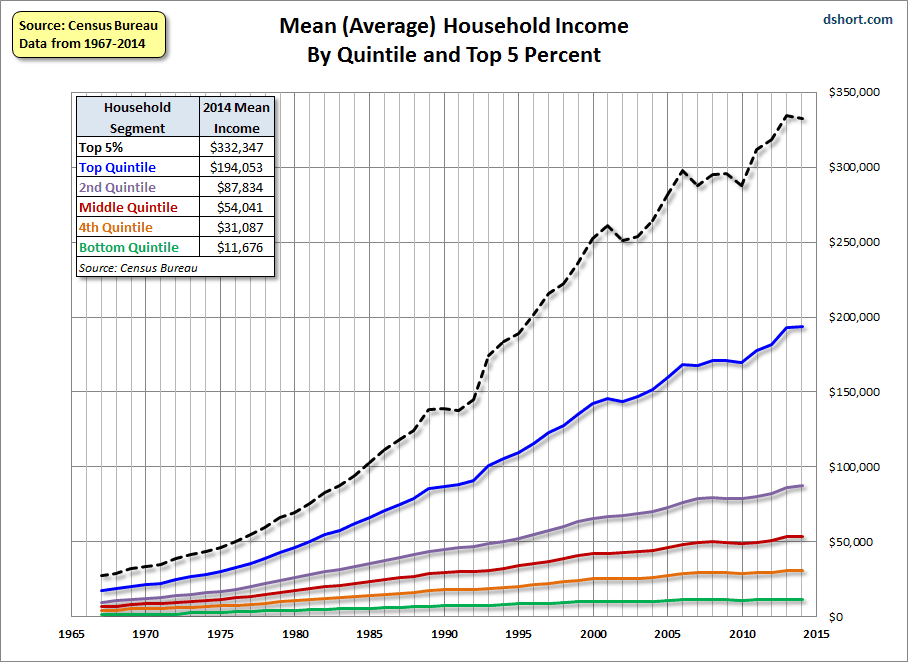
And, they aren't wrong. It's a clear and obvious picture that the income of the wealthiest is increasing dramatically whereas the poorest are getting a worse deal. While worker productivity has increase over 70% in the US since 1970, wages of the average workers haven't increased at all in that time so the obvious conclusion is that these increases are going straight to the top of society as shown in this graph.
 We've got to fix a broken system. There's a variety of ways I think this can be done. First is reducing shareholder power in corporations. This is by far the biggest problem with the current system in my view. In the US, it's predicted that this year will be the first year on record that the amount businesses spend on share buybacks will outweigh that of actual reinvestment in their businesses. Meanwhile, big businesses are encouraged to cut costs by laying off employees and trying to press wages lower. This means corporations are becoming a machine to artificially increase share prices short term whilst ignoring long term effects, 'short-termism' as it's called, hugely weakens economic growth and exacerbates income inequality.
The next is a larger in work welfare system. An obvious alternative, that's being adopted in many countries around the world, is a high minimum wage. I don't think that's the right policy. A high minimum wage may help push up wages but, it mainly affects the retail and care industries who have very low profit margins so forcing them to push up wages will only pass on the costs to the consumer, in the two industries where low prices are perhaps most important. High minimum wages also lead to increased unemployment and an incentive for businesses to move to automating more and more low-skill workers. If the cost of labour is artificially increased against the market it will just quicken this. So, instead of George Osborne cutting tax credits, we should actually increase them because in a more automated economy, the role of the government in redistributing wealth and topping up wages will be more important than ever.
But, how will this be paid for? A fairer tax system is absolutely required. Cutting tax avoidance of corporations is an absolute priority. Also, putting an end to the damaging 'race to the bottom' of corporation taxes which is slowly but surely turning countries like the UK into tax havens. I'm not suggesting these are the only options or that they will work in practice, but, the need to finally start tackling income inequality has never been greater.
One of the big factors in causing this, in my view at least, is ever increasing income inequality. On the right, people are feeling worse off and blaming globalisation, immigrants coming over and suppressing their wages. On the left, they blame the wealthy for taking a larger and larger share of their country's wealth and income.
And, they aren't wrong. It's a clear and obvious picture that the income of the wealthiest is increasing dramatically whereas the poorest are getting a worse deal. While worker productivity has increase over 70% in the US since 1970, wages of the average workers haven't increased at all in that time so the obvious conclusion is that these increases are going straight to the top of society as shown in this graph.
The next is a larger in work welfare system. An obvious alternative, that's being adopted in many countries around the world, is a high minimum wage. I don't think that's the right policy. A high minimum wage may help push up wages but, it mainly affects the retail and care industries who have very low profit margins so forcing them to push up wages will only pass on the costs to the consumer, in the two industries where low prices are perhaps most important. High minimum wages also lead to increased unemployment and an incentive for businesses to move to automating more and more low-skill workers. If the cost of labour is artificially increased against the market it will just quicken this. So, instead of George Osborne cutting tax credits, we should actually increase them because in a more automated economy, the role of the government in redistributing wealth and topping up wages will be more important than ever.
But, how will this be paid for? A fairer tax system is absolutely required. Cutting tax avoidance of corporations is an absolute priority. Also, putting an end to the damaging 'race to the bottom' of corporation taxes which is slowly but surely turning countries like the UK into tax havens. I'm not suggesting these are the only options or that they will work in practice, but, the need to finally start tackling income inequality has never been greater.
Comments
Post a Comment